
Dual plumbing in apartments means 2 separate pipe lines: one for fresh water and one for treated water from the sewage treatment plant (STP). The treated line feeds toilet flush tanks, which use a large share of a home’s daily water. In Bengaluru, the 2024 shortage sent many high-rises to tankers. Dual plumbing, rainwater harvesting and a meter per flat cut that need.
How dual plumbing works in a flat
In a normal home, one set of pipes carries the same water to every tap. Kitchen, shower and toilet all draw from 1 tank. So a 500-home building flushes clean, costly water down the drain many thousand times a day.
Dual plumbing splits this in 2. The first line brings fresh water to the kitchen, wash basins, showers and the washing machine. The second line brings treated water to the toilet cisterns only. Plumbers use different pipe colours or tags, so the 2 lines never mix.
The treated water comes from the project’s own STP. Waste water from all homes flows to the plant. The plant cleans it in 3 or 4 stages and pumps it to a separate overhead tank. From there, it runs down the second pipe line to each flush, on every floor of a G+25 tower.
| Point of use | Line in a dual system | Why |
|---|---|---|
| Kitchen sink | Fresh water | Cooking and drinking |
| Wash basin and shower | Fresh water | Direct contact with skin |
| Washing machine | Fresh water | Clothes touch skin |
| Toilet flush | Treated STP water | No contact, large volume |
| Garden and lawns | Treated STP water | Common-area use, set by the association |
| Car wash bay | Treated or fresh, by project | Varies by project |
Flushing uses more water than cooking and drinking combined. A single flush on an older cistern can use 6 to 10 litres. A family of 4 may flush 20 or more times a day. Sending STP water to that job saves fresh water for the kitchen and the shower.
STP: the plant behind the second pipe
An STP is a small treatment works inside the project. It takes the waste water from toilets, kitchens and baths and cleans it in 3 main stages. In stage 1, screens catch solids. In stage 2, air and bacteria break down the rest. In stage 3, filters and a disinfection step make the water fit for flushing and gardens.
Karnataka has had STP rules for apartments since 2016. That year, Karnataka’s Department of Forest, Ecology and Environment issued an order on STPs. It covered apartments with 20 or more units or 2,000 sq m or more of built-up area. In March 2024, news reports said the state eased this for projects below 120 units that can link to a city sewer line. Large gated projects above that size still run their own plants.
The Karnataka State Pollution Control Board (KSPCB) sets the quality limits for treated water. Its standards cover measures such as BOD, COD and suspended solids. A well-run plant meets these and keeps the smell away, compared with a neglected one that fails both tests.
This is why STP care shows up in your monthly bill in Bengaluru. The plant needs power 24 hours a day, trained operators, chemicals and lab tests. Our guide to apartment maintenance charges shows where this sits in the budget.
| STP check for buyers | What a good answer sounds like |
|---|---|
| Plant capacity | Sized for all homes at full occupancy |
| Where treated water goes | Flushing, gardens, and any surplus use |
| Who runs it | A trained operator on every shift |
| Testing | Regular lab tests against KSPCB limits |
| Sludge handling | A clear plan for removal and disposal |
Rainwater harvesting: Bengaluru’s rules
Rainwater harvesting (RWH) catches rain from roofs and paved areas. The water either goes into a storage sump for use or into recharge pits that feed the ground. Many large Bengaluru sites use both, with a sump for the first rains and pits for the overflow.
In Bengaluru, BWSSB rules make RWH mandatory for many buildings. The BWSSB Amendment Act of 2011 applies it to plots of 60 x 40 ft (2,400 sq ft) and above. It also applies to new buildings on 30 x 40 ft (1,200 sq ft) sites. Large apartment projects fall well inside these limits.
BWSSB enforces the rule through the water bill. News reports on its 2015 regulations say a home without RWH pays 25% extra on its water and sanitary charges. That applies for the first 3 months. After that, the extra charge rises to 50% until the owner puts RWH in place. Figures in this section are as of September 2026. Rules and fines can change, so check with BWSSB for a specific building.
Bengaluru gets most of its rain from June to October. A large site with many roofs can catch a lot of it in those months. Stored rain can cut tanker trips. Recharge pits can also help borewells hold up in the 3 dry months of March, April and May.
| Rule or fact | Detail (as of September 2026) |
|---|---|
| Law | BWSSB Amendment Act, 2011 |
| Plots covered | 60 x 40 ft and above; new builds on 30 x 40 ft |
| Penalty, first 3 months | Extra 25% of water and sanitary charges |
| Penalty after 3 months | Extra 50% until RWH is in place |
| Main rain months | June to October |
This is general information, not legal advice. For a Bengaluru building permit or a penalty notice, check the current rules with BWSSB or a qualified adviser.
Water meters for every flat
A shared water bill is a common source of fights in Bengaluru apartments. Without meters, the association splits the bill by flat size or equally. A couple who travel often pays the same as a family of 6 who never leave.
A meter on each flat’s fresh-water inlet fixes this. The association reads each meter once a month and bills by use. Homes that save water pay less than homes that waste it. The meter also helps find leaks. A jump of 2 or 3 times in one flat’s reading can point to a running cistern or a burst pipe.
Meters work best when the building also has a clear water plan. That means dual plumbing for flushing, an STP for reuse and RWH for recharge, plus 1 meter per flat. Together, these 4 parts cut the fresh water each home needs.
| Feature | What it saves or fixes |
|---|---|
| Dual plumbing | Fresh water that would go to flushing |
| STP | Waste water reused for flush and gardens |
| Rainwater harvesting | Rain stored or sent to recharge the ground |
| Meter per flat | Fair billing and early leak alerts |
What Adarsh Welkin Park’s specs say about water
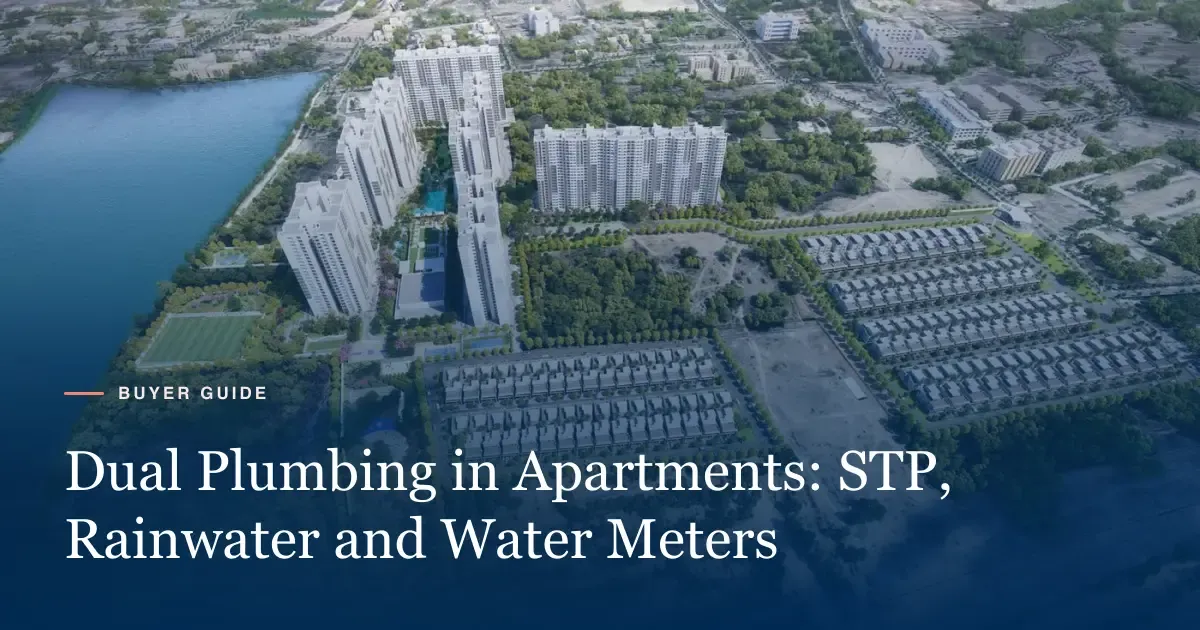
Adarsh Welkin Park is a large gated project in Gattahalli, off Sarjapur Road, on Rayasandra Road beside Gattahalli Lake. The developer’s specifications cover all 4 water features in this guide.
The plumbing specs list dual piping, with fresh water for use and treated water for flushing. They also list a water meter for every flat, plus CP fittings and PVC drainage and storm-water pipes. Under safety and utilities, the Welkin Park specs name rainwater harvesting and a sewage treatment plant.
The amenities also include a lap pool, a leisure pool, a kids’ pool, a jacuzzi and shallow water bodies. Each needs its own water care, separate from the 2 pipe lines in your home. And the master plan shows 72% open space, with lawns and a Miyawaki forest that a treated-water line can serve.
The brochure does not give the STP capacity or the water source mix. Ask for both at the site office. Our site visit checklist lists 6 water checks to take with you.
Questions to ask about water before you buy
Water is harder to fix after you move in than before you book. So ask these 6 questions for any project you shortlist in Bengaluru.
- Does every home have dual plumbing, and which points get treated water?
- What is the STP capacity, and is it sized for full occupancy?
- Who will run the STP after handover, and will they test the water every 30 days?
- How many litres of rain can the RWH system store or recharge?
- Does each flat have its own water meter, and will the monthly bill follow the reading?
- What share of water will come from BWSSB supply, borewells or tankers?
Write the answers down and compare them across 2 or 3 projects. If a sales team cannot answer a question on the spot, ask for the reply in writing within a week. A clear written answer on water is worth more than a glossy brochure page.
Write the scores in a simple table with 1 row per project. A project with all 4 features in place may cost a little more to run. It can still save money over 10 years if it avoids tanker bills in the dry months.
For more buyer guides for Sarjapur Road, see our blog. For the project overview, visit the homepage.
Considering Adarsh Welkin Park?
Get the official brochure, floor plans and latest price sheet from our relationship manager.
Frequently asked questions
Dual plumbing means 2 separate pipe networks in each home. One carries fresh water to taps, showers and the kitchen. The other carries treated water from the sewage treatment plant to toilet flush tanks.
Yes, when the plant runs well. The Karnataka State Pollution Control Board sets standards for treated water used for flushing and gardening, and the association should test it on a fixed schedule.
Yes, for many buildings. Under the BWSSB Amendment Act of 2011, it applies to plots of 60 x 40 ft and above and to new buildings on 30 x 40 ft sites. BWSSB adds a penalty to the water bill of homes that do not comply.
A meter per flat lets the association bill each home for what it uses. Without one, a family of 2 pays the same share as a family of 6, which often leads to waste.
Yes. The developer's specification list includes dual piping, with fresh water for use and treated water for flushing, plus a water meter for every flat, an STP and rainwater harvesting.
Published by IamHere Realty, authorised channel partner for Adarsh Welkin Park. Project details are from the developer’s official material; verify every detail with the sales team before you decide.