
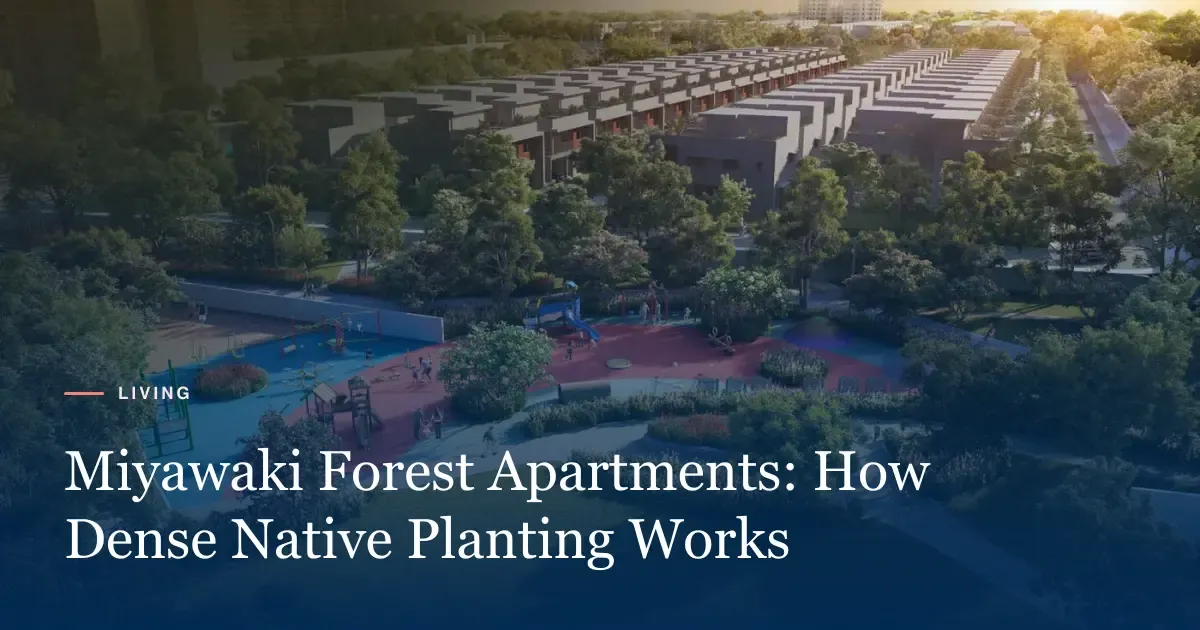
Miyawaki forest apartments sit in gated projects that plant small, dense patches of native trees inside the campus. The method packs about 3 to 5 saplings into each square metre, so the patch looks like a thicket within a few years. This guide explains how the method works, what the 2026 evidence says, and what to check. Adarsh Welkin Park, off Sarjapur Road, is our worked example.
Where the Miyawaki method comes from
Akira Miyawaki was a Japanese botanist who lived from 1928 to 2021. In the late 1950s he studied with the German scientist Reinhold Tüxen. Tüxen worked on “potential natural vegetation”, the plants that would grow on a site with no people around.
Miyawaki used that idea to pick native species for each site. He began planting his small, dense forests in Japan in the 1970s. Over the next 40 years, the method spread to many other countries.
The idea reached Bengaluru through industry. Per news reports, engineer Shubhendu Sharma heard Miyawaki speak at the Toyota plant near Bengaluru in 2008. He helped plant a forest there in 2009 and founded Afforestt in 2011. That firm has since planted mini forests in several countries.
How a Miyawaki forest is planted
The recipe has 4 main steps. Each one differs from a normal garden bed.
| Step | Miyawaki forest | Typical apartment garden |
|---|---|---|
| Species | Many kinds of native trees and shrubs | A few ornamental plants, often non-native |
| Density | About 3 to 5 saplings per sq m | 1 tree every few metres |
| Layers | Canopy, tree, sub-tree and shrub layers | Mostly lawn, hedge and single trees |
| Soil | Dug and enriched once before planting | Topsoil and regular fertiliser |
| Mulch | A thick layer of straw or wood chips | Little or none |
| Care | Weeding and watering for 2 to 3 years | Mowing and pruning for good |
| Use | Look at, walk past, listen to birds | Sit on, play on, host events |
First, the team studies which trees grow wild in the region. In Bengaluru that means species native to the Deccan plateau, not a copy of a Japanese forest.
Second, the soil gets dug deep and mixed with compost and organic matter. Groups like SUGi describe this as a one-time fix.
Third, the saplings go in close together, mixed across 4 layers. Crowded plants race each other for light, so they grow up faster than out.
Fourth, the bed gets a thick mulch. Then comes 2 to 3 years of weeding and watering. After that, groups that plant these forests say care can drop.
What the evidence says in 2026
Promoters often claim that Miyawaki forests grow 10 times faster, are 30 times denser and hold 100 times more life than a plantation. Scientists have pushed back on those figures.
A review in the Journal of Applied Ecology, published in late 2025, looked at 51 studies. Only 41% of them measured results with numbers. Only 33% compared the forest with a control plot, and only 14% repeated the test.
The review rated the 10 times faster growth claim as partly supported. It was the best-backed claim of the set. Claims about much higher biodiversity and a forest that needs no care after 3 years rated weak or unproven.
What does this mean for a flat buyer? Treat a mini forest as a pleasant, dense green patch that grows fast in its first 5 years. Do not treat it as a carbon sink or a wildlife reserve on the strength of a brochure.
Why gated projects plant mini forests
Space is the first reason. A Miyawaki patch can fit into a small corner, and some groups plant them on plots under 10 square metres. That suits a campus where towers, roads and courts take most of the land.
Speed is the second reason. Buyers in a new project want shade and green soon after they move in. Dense saplings close their canopy in a few years, faster than a row of single trees.
A third reason is the feel of the place. A patch of 3 or 4 metre trees breaks the view of concrete. It also gives birds, butterflies and small insects a place to live.
There is a sales reason too, and it is fair to name it. “Miyawaki forest” reads well in a brochure. Your job is to check whether the forest on paper gets the space and care it needs.
Trade-offs to weigh
A mini forest is less useful than a park for play. At 3 to 5 plants per square metre, it is too dense to walk into. You enjoy it from a path or a deck. If you want a lawn for children to run on, look for that on the plan as well.
The first 2 to 3 years can look untidy. Mulch, bare stems and thin saplings do not match the lush image in a brochure render. Most of the green comes later than the handover photos suggest.
Upkeep costs money. In year 1, a patch may need weeding every few weeks. Once the builder hands over, the residents’ association pays for weeding, water and any lost saplings. Ask for an estimate of that cost as a share of your maintenance bill.
Water is the last point, and it matters more than in wetter cities. Bengaluru’s dry months, from about February to May, stress young plants. Ask where the water for the landscape will come from in those months.
How a mini forest changes daily life
For residents, the gains are small but real. A dense patch 3 or 4 metres tall gives shade to the path beside it. It also softens noise from a nearby road, though a strip a few metres deep will not block traffic sound on its own.
Birds are the most visible change. A native mix feeds more insects than a lawn, and birds follow the insects. In Bengaluru that can mean bulbuls, sunbirds and butterflies within 2 or 3 years of planting.
There is a cost side too. Leaf litter builds up, and some residents dislike the “wild” look next to a clipped lawn. Snakes and rats can shelter in any dense cover. A good care plan keeps a clear 1 to 2 metre edge along paths and play areas.
Miyawaki forests at Adarsh Welkin Park
The developer’s master plan lists 80 numbered features. Two of them are Miyawaki patches: a “Miyawaki forest” and an “experience lawn with Miyawaki forest”. The second pairs a dense patch with open lawn, which answers the “you cannot walk in it” problem.
Several nearby features fit the same nature theme. The Welkin Park plan shows a boardwalk, a natural trail, a butterfly garden, a coconut grove and an aroma garden. It also marks tropical planting and a maze garden. That is 7 green features on top of the 2 Miyawaki patches. See the full list under amenities.
The brochure says 72% of the land at Welkin Park stays open, with 75+ amenities in all. The site also sits beside Gattahalli Lake. We covered what a lake edge means in our guide to lake facing apartments in Bangalore.
Some details are missing from the Welkin Park brochure. It does not give the size of each Miyawaki patch, the species list or the care plan. Ask for those in writing, along with which towers sit closest to the forest.
6 questions to ask before you buy
- How big is each patch? Ask for the area in square metres, say 100 or 500. A 100 sq m patch holds 300 to 500 saplings at the usual density.
- Which species? A good list names many native trees and shrubs across all 4 layers, not just ornamentals.
- Who plants it? Ask if a specialist firm plants it or the general landscape contractor.
- Who cares for it, and for how long? Ask for 2 to 3 years of care in the contract, and the handover terms.
- What water will it use? Ask whether treated water from the site’s sewage plant can reach the landscape.
- How far from your flat? A forest 50 metres from your balcony adds more than one on the far side of an 8-tower campus.
Read the project overview for the full scale, or browse more guides on the blog.
Book a site visit to walk the Welkin Park landscape plan
Considering Adarsh Welkin Park?
Get the official brochure, floor plans and latest price sheet from our relationship manager.
Frequently asked questions
It is a small, dense patch of native trees and shrubs, planted at about 3 to 5 saplings per square metre on prepared soil. Japanese botanist Akira Miyawaki developed the method in the 1970s.
A review of 51 studies in the Journal of Applied Ecology rated the faster-growth claim as partly supported. It rated claims about far higher biodiversity and long-term self-care as weak or unproven.
Groups that plant them, such as the SUGi project, say the first 2 to 3 years need weeding and watering. After that, care drops as the canopy closes.
Yes. The developer's master plan lists a Miyawaki forest and an experience lawn with a Miyawaki forest. The plan also shows a boardwalk, a coconut grove, a butterfly garden and a natural trail.
The builder's team or its landscape firm usually cares for it until handover. After that the residents' association pays for upkeep, so ask for the care plan and the cost in writing.
Published by IamHere Realty, authorised channel partner for Adarsh Welkin Park. Project details are from the developer’s official material; verify every detail with the sales team before you decide.