
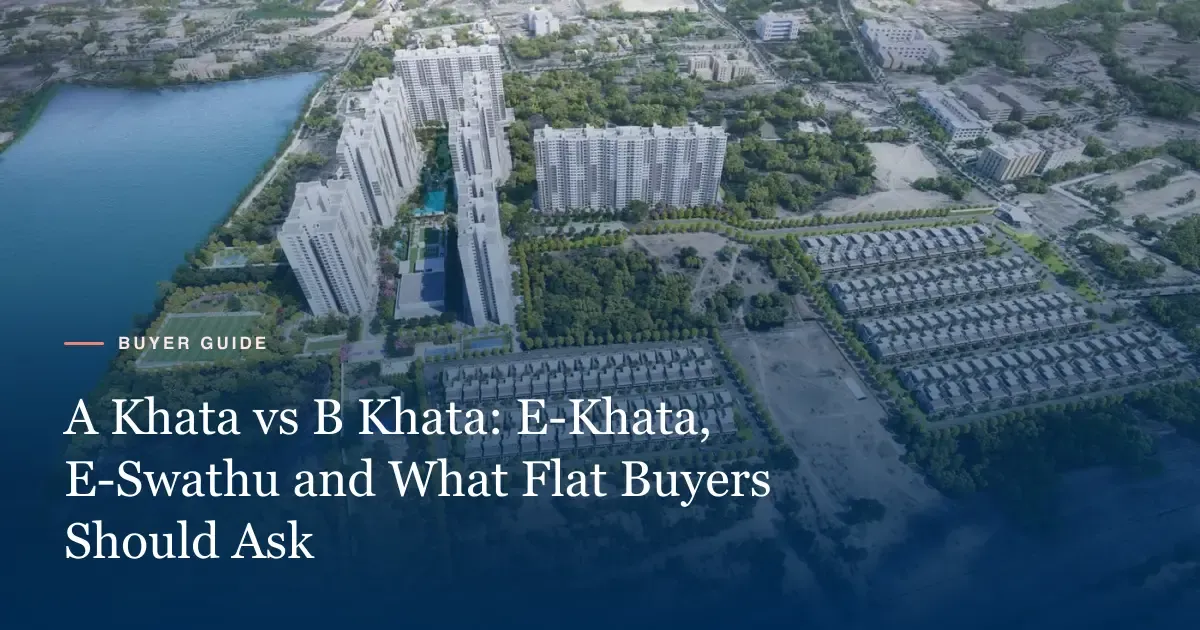
In Bengaluru, an A khata records a property that meets planning rules. A B khata records one with approval gaps, so the city can still tax it. Since 1 October 2024, sub-registrars need a final e-khata to register a sale within city limits. Outside the city, in panchayat areas, the record comes through e-swathu as Form 9 or Form 11. This guide explains all three, as of September 2026.
What a khata is and why it matters
A khata is the local body’s record of a property in Karnataka. It shows who owns it, its size and the tax due. A khata is less than a title deed. Your sale deed proves ownership; the khata proves the local body has you on its books.
You need the khata for at least 4 things after you buy in Bengaluru. You pay property tax against it each year. Banks in Bengaluru ask for it before a loan and again at resale. BESCOM and the water board may ask for it for new connections. And when you sell, the buyer’s lawyer will check it before the sale agreement.
In Bengaluru, the city body used to be the BBMP. On 2 September 2025, the state replaced it with the Greater Bengaluru Authority and 5 city corporations, per Deccan Herald. The BBMP-era khata rules below carried over to the new bodies.
A khata vs B khata: the key differences
The labels come from 2 registers that the BBMP kept. The A register held Bengaluru properties that met the rules. The B register held properties with gaps, so the BBMP could still collect tax from them.
| Point | A khata | B khata |
|---|---|---|
| What it records | Property that meets planning and building rules | Property with approval gaps, such as an unapproved layout |
| Building plan | Approved plan on record | Often no approved plan, or deviations |
| Property tax | Paid | Paid, but paying tax does not make it legal |
| Building licence for new work | Can be issued | Often refused |
| Home loans | Most banks lend | Many banks refuse or lend less |
| Resale | Easier, with more buyers | Harder, with fewer buyers and lenders |
The key point is simple. A B khata in Bengaluru does not mean the owner is not the owner. It means the property has a problem with approvals. That problem can limit loans, repairs and resale until the owner fixes it.
For a new flat in a RERA-registered project, you should expect an A khata or its panchayat equivalent. If a builder mentions a B khata for a new project, stop and ask why.
E-khata and the 2025 changes in Bengaluru
Karnataka moved Bengaluru’s khata records online as e-khata, through the e-Aasthi system. Per Deccan Herald, the state made e-khata mandatory for property registration from the end of September 2024. In practice, sub-registrars began asking for it from 1 October 2024.
There are 2 kinds of e-khata in Bengaluru. A draft e-khata is an automatic record made from old BBMP data. A revenue officer then checks your papers and approves a final e-khata. Only the final one works for a sale deed, a loan or a transfer.
In 2025, the city also opened a way out for some B khata owners. Per Deccan Herald, the Greater Bengaluru Authority ran a one-time scheme from 1 November 2025. It gave owners 100 days to apply to move from B khata to A khata. The fee was 5% of the guidance value of the site.
That scheme had limits. It covered vacant plots and plots with 1 single-unit building. News reports said flats and multi-storey buildings were not eligible. So a flat buyer in Bengaluru should not rely on a later conversion to fix a B khata.
Outside the city: panchayat khata and e-swathu
Many new projects on Bengaluru’s edge sit outside the city corporations. They fall under a gram panchayat instead. Here, the property record comes through e-swathu, the Karnataka Rural Development and Panchayat Raj Department’s system.
| Record | What it is, in broad terms |
|---|---|
| Form 9 | The panchayat’s record of a non-farm property, issued for authorised properties |
| Form 11A | The matching record for authorised properties in the new format |
| Form 11B | The record for properties that fail the authorised tests, the rural version of a B khata |
Lender and legal guides say a sub-registrar asks for Form 9 or Form 11 before registering a sale in a panchayat area. The rules here have changed in the last 2 years. In 2025, the state passed an amendment to the Karnataka Gram Swaraj and Panchayat Raj Act. Per news reports, it lets panchayats give B khatas to about 90 lakh unauthorised village properties. Guides also report a late-2025 e-swathu update that needs GPS mapping before the panchayat issues a form.
Sources use the 3 form names in different ways. Treat the table as a guide, and ask a property lawyer which form your flat will get.
A panchayat khata is not worse than a city khata by itself. What matters is whether the project has the right approvals. A panchayat-area project should still have a plan sanction from the planning authority for that area. It should also have land converted for non-farm use and a RERA number. You can check the last one with our Karnataka RERA check steps.
Where Gattahalli fits
Adarsh Welkin Park is at Gattahalli Village, Sarjapur Hobli, Anekal Taluk, Bengaluru 560099. The Greater Bengaluru Area notified in 2025 covers about 721 sq km. As far as we can tell, Gattahalli sits outside it, in the rural belt of Anekal taluk. Census-based village directories list Gattahalli under the Shanthipura gram panchayat.
If that holds, flats here would get a panchayat record through e-swathu rather than a city e-khata. But we could not confirm this from an official source. The state has also discussed adding areas to Greater Bengaluru over time. So the local body could change before handover.
This is why you should ask the developer in writing. The questions below cover what you need. You can see the site’s setting on Rayasandra Road on our location section.
What flat buyers should ask the developer
Ask these 7 questions before you sign the agreement for sale. Ask for copies, not just verbal answers.
- Which local body covers the land today: a Bengaluru city corporation or a gram panchayat?
- Which khata or e-swathu form does the land hold now, and in whose name?
- What record will each flat get after the sale deed, and in which year?
- Which authority sanctioned the building plan, and on what date?
- Is the land converted for non-farm residential use under Karnataka law?
- Who will apply for the flat’s khata transfer after registration, and at what cost in ₹?
- Has ICICI Bank, Tata Capital Housing Finance or any other lender raised khata questions in its legal check?
The Karnataka sub-registrar will need the right record on the day of your sale deed. Our stamp duty Bangalore 2026 guide explains the rest of that day’s costs. Banks also check property records during their legal check, as our home loan for under construction flat guide explains.
Khata transfer, property tax and resale
After registration, you apply to transfer the khata into your name. For a Bengaluru city e-khata, that goes through e-Aasthi. For a panchayat record, it goes through e-swathu. Apply soon after the sale deed, since the local body’s fee and papers can take time. The developer’s team often helps with the first transfer in a new project of 500+ homes.
Pay property tax each year from the first year. Unpaid tax builds up with penalties, and a buyer’s lawyer will ask for past receipts at resale. Keep the tax receipts with your sale deed and the khata extract, in 1 folder.
The khata also matters when you sell in Bengaluru. A buyer’s bank will check the same record your bank checked. An A khata or a clean panchayat Form 9 or 11A makes that check faster than a B khata or 11B record. In a market like Sarjapur Road, with many new launches, a clean record helps your flat compete at resale.
| Stage | Record to keep | Where it comes from |
|---|---|---|
| Before booking | Land khata or e-swathu form, RERA certificate | Developer |
| At the sale deed | Final e-khata or Form 9 / 11 for the flat | Local body, via the developer |
| After the sale deed | Khata transfer in your name | e-Aasthi or e-swathu |
| Every year | Property tax receipts | Local body |
This article is general information as of September 2026, not legal advice. Khata rules in Karnataka changed often in 2024 and 2025, so confirm your case with a property lawyer and the local body.
Ask our relationship manager for the khata and approval details
Considering Adarsh Welkin Park?
Get the official brochure, floor plans and latest price sheet from our relationship manager.
Frequently asked questions
An A khata records a property that meets the city's planning and building rules. A B khata records a property with gaps in approvals, so the city can collect tax. Banks lend more freely on A khata homes.
Yes, within city limits. Since 1 October 2024, sub-registrars in Bengaluru need a final e-khata to register a sale. A draft e-khata is not enough.
Not under the 2025 scheme. The Greater Bengaluru Authority's one-time scheme from 1 November 2025 covered vacant plots and single-unit buildings, and news reports said flats were not eligible.
E-swathu is the Karnataka Rural Development and Panchayat Raj Department's online record for properties in gram panchayat areas. It issues the Form 9 and Form 11 records that a sub-registrar asks for.
Gattahalli is in Anekal taluk and appears to be outside the Greater Bengaluru city limits, so a panchayat record through e-swathu is likely. Ask the developer to confirm the local body and the record you will get.
Published by IamHere Realty, authorised channel partner for Adarsh Welkin Park. Project details are from the developer’s official material; verify every detail with the sales team before you decide.